
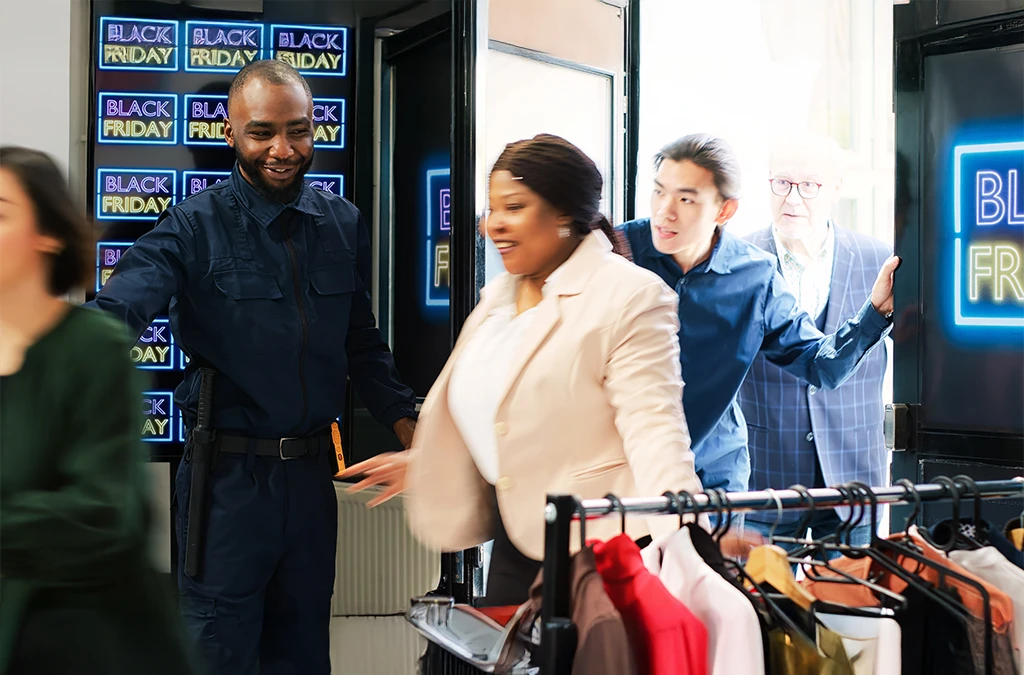
Whether you shop in-store or online, the day after Thanksgiving — aka Black Friday — is still a huge day for retailers and consumers.
The term “Black Friday” was first used to reference a financial crisis, not shopping. On September 24, 1869, two Wall Street financiers tried to corner the U.S. gold market, causing a market crash and widespread panic.
The retail sales origin of Black Friday comes from Philadelphia in the 1950s, where the Army-Navy football game is played on the Saturday following Thanksgiving every year. The game brought in hordes of people, causing a major headache for local police, who used the term to describe the heavy traffic, crowds, and disorder. Retailers in Philadelphia typically saw a sales spike from all the people in town, and began calling the day Black Friday as well. In the 1980s, the name went national, adopting the myth that it was the day retailers finally moved from the red (losses) into the black (profits) for the year.
Black Friday remains the biggest day of foot-traffic of the year for many stores who throw major sales events, with early openings and deep discounts. Consider the following statistics from Black Friday 2024 in the U.S.:*
$11.3 million per minute was spent between 10:00 a.m. and 2:00 p.m.
81.7 million: The number of U.S. shoppers in a physical store
87.3 million: U.S. shoppers made their purchases online
$10.8 billion: The amount spent online in the U.S., up 10.2% from the year prior
$74.4 billion was spent globally in the 24-hour period
69% of global purchases were made on mobile devices
87.3 million: U.S. shoppers made their purchases online
$10.8 billion: The amount spent online in the U.S., up 10.2% from the year prior
$74.4 billion was spent globally in the 24-hour period
69% of global purchases were made on mobile devices
Cyber Monday, introduced in 2005, extended the frenzy to e-commerce sales on the following Monday, and in the 2010s, Black Friday became a global phenomenon… adopted by the UK, Canada, and Australia. The Covid-19 pandemic further shifted consumer activity online, leading to extended sales periods — sometimes starting in early November.
If advertisers are to be believed, the best bargains are still to be had from Black Friday through Cyber Monday, a four-day period now known in the retail world as BFCM. That may be especially true for big ticket items, seasonal merchandise and the latest trendy products. Despite Cyber Monday and digital sales, why do many retailers still rely on Black Friday?
- Boost traffic: Black Friday is still the anchor event that gets people into stores (and onto websites), builds excitement and brings heavy footfall or site traffic. In-store experience (touch, feel, immediate gratification) remains something online can’t fully replicate.
- Impulse buys: Retailers know that during this event customers will buy things they may not have planned.
- Momentum: Black Friday acts as a kind of “kick-off” to the holiday shopping season. Retailers gauge consumer sentiment, product demand, inventory performance and may use the day’s performance to shape their remaining holiday strategy.
- Tradition: There’s a cultural expectation and tradition around Black Friday — consumers are primed to shop, expecting deals — so while digital commerce is strong, the big event day still resonates.
- Foot traffic matters: Even in a digital age, physical stores still want to drive people through the doors for upsell, servicing, returns, pick-up, etc.
- Differentiation: The “limited-time door-buster” format still creates urgency. While Cyber Monday and other digital promos are huge, the day after Thanksgiving still has a sense of “event” that many other days don’t.
The Frenzy over Deals over the Years
2010. Urban Outfitters decided to create an outrageous promotion for Black Friday—offering $1 mystery bags. The bags contained surprise items and drew massive crowds. As soon as the store opened, chaos erupted, with customers practically stampeding to grab as many of the bags as they could. A viral video from the event showed people leaping over counters and ripping open bags in the store to see what treasures they contained… the thrill of the $1 bargain.
2011. A security guard for Target arrived at work and noted the couple first in line outside the store said they had been waiting for 14 hours… their target? $2 towels. When he left his shift 12 hours later, he saw that a supply of towels still remained in the store.
2013. A shopper in a Los Angeles Walmart took “competitive shopping” to a new level of absurdity. When a crowd of people swarmed to grab Xbox consoles on sale, one woman reportedly panicked and pulled out a can of pepper spray, using it to fend off other shoppers. Around 20 people were treated for exposure to the spray. The woman reportedly paid for her Xbox and slipped away into the crowd, only to later turn herself in to the police.
2014. Footage showed dozens of eager bargain hunters wrestling one another over 30 Samsung television sets that disappeared in under two minutes at a Tesco store in Batley, West Yorkshire. The escalators were blocked to stop overcrowding.
2014. A group of shoppers set up tents two weeks before Black Friday outside of a Best Buy in California. While they camped outside in the cold, they could be seen sitting comfortably inside the tents ,playing video games on laptops and watching TV.
2017. Shoppers at British appliance store Currys PC World were eager to get their hands on discounted washing machines and dryers. As the doors opened, people rushed inside, and one reportedly jumped inside a tumble dryer to “secure it” while waiting for a store assistant. The sight of him crammed into the dryer, guarding his purchase, became a viral sensation. His strategy paid off—no one dared to challenge him for the appliance.